Zwei Planeten
Bis zum Monatsende verlängert sich der helle Tag um fast eineinhalb Stunden gegenüber dem Winteranfang. Die Sonne bewegt sich in diesem Monat vor dem Tierkreissternbild Schütze und ab 20. vor dem Steinbock. Am 3. zieht die Erde durch den sonnennächsten Punkt ihrer jährlichen Bahn.
Vollmond ist am 3. Januar, Neumond am 18.
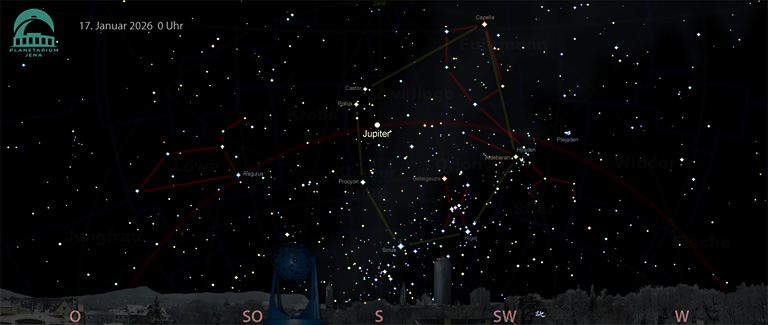
Schon am frühen Abend erscheint im Osten der Riesenplanet Jupiter vor dem Tierkreissternbild Zwillinge. Am 10. steht er in Opposition zur Sonne, ist also die ganze Nacht sichtbar. Saturn steht am frühen Abend im Südwesten. Er bewegt sich rechtläufig, also von West nach Ost, vor dem Tierkreissternbild Wassermann, ab dem 15. vor dem Tierkreissternbild Fische.
Am westlichen Nachthimmel zeigen sich die Sterne des Herbstvierecks und der Sternkette aus Pegasus und Andromeda. Den Südhimmel dominieren die hellen Sterne des Wintersechsecks. Besonders auffällig ist das Sternbild Orion mit dem rötlichen Schulterstern Beteigeuze und dem weiß-bläulichen Fußstern Rigel. Die drei Gürtelsterne des Orions weisen in der Verlängerung nach rechts oben zum Aldebaran im Sternbild Stier, nach links unten zum hellsten Stern am irdischen Himmel, Sirius im Sternbild Großer Hund. Darüber schließen Prokyon im Kleinen Hund, die Zwillinge Kastor und Pollux sowie Kapella im Fuhrmann das Wintersechseck.
In der zweiten Nachthälfte funkeln die Sterne im Trapez des Löwen, Regulus führt das Frühlingsdreieck an.
W. Don Eck
Zeiss-Planetarium Jena
Sun, Moon, planets and stars in January 2026
Two planets
By the end of the month, daylight hours will have increased by almost an hour and a half compared to the beginning of winter. This month, the Sun will move across the zodiac constellation of Sagittarius and, from the 20th, Capricorn. On the 3rd, the Earth will pass through the point in its annual orbit closest to the Sun.
The full moon will be on 3 January and the new moon on 18 January.
In the early evening, the giant planet Jupiter appears in the east in front of the zodiac constellation Gemini. On the 10th, it is in opposition to the Sun, meaning it is visible all night long. Saturn is in the southwest in the early evening. It moves in a regular direction, i.e. from west to east, in front of the zodiac constellation Aquarius, and from the 15th onwards in front of the zodiac constellation Pisces.
The stars of the Autumn Square and the chain of stars from Pegasus and Andromeda appear in the western night sky. The bright stars of the Winter Hexagon dominate the southern sky. The constellation Orion is particularly striking with the reddish shoulder star Betelgeuse and the white-bluish foot star Rigel. The three belt stars of Orion point upwards to the right to Aldebaran in the constellation Taurus, and downwards to the left to the brightest star in the Earth’s sky, Sirius in the constellation Canis Major. Above them, Procyon in Canis Minor, the twins Castor and Pollux, and Capella in Auriga complete the Winter Hexagon.
In the second half of the night, the stars in the Trapezium of Leo twinkle, with Regulus leading the Spring Triangle.