Der Herbst beginnt
Am 23. des Monats verabschiedet sich mit der Tagundnachtgleiche der diesjährige Sommer astronomisch und kalendarisch, bei uns auf der Nordhalbkugel beginnt der Herbst. Von Jena aus gesehen quert die Sonne um 2:04 Uhr Sommerzeit den Himmelsäquator in Richtung Süden. Sie hat am 17. das Tierkreissternbild Löwe verlassen und ist vor die Jungfrau gezogen.
Vollmond ist am 26. September, Neumond am 11.
Venus erstrahlt am 19. in größter Helligkeit, geht aber immer früher im Südwesten unter und verabschiedet sich am Ende des Monats.
Ab 6. befindet sich im Osten der Ringplanet Saturn vor dem 13. Tierkreissternbild Walfisch. Erst am 4. Oktober erreicht er seine Oppositionsstellung zur Sonne.
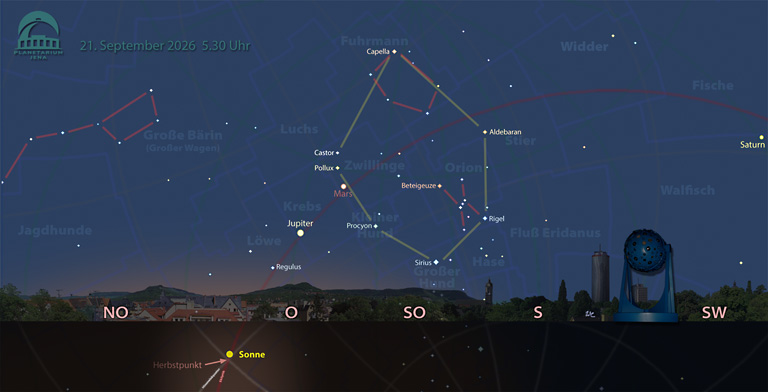
In der zweiten Nachthälfte erscheinen im Osten der rote Planet Mars vor dem Tierkreissternbild Zwillinge, ab 25. vor dem Tierkreissternbild Krebs, und der Riesenplanet Jupiter vor dem Tierkreissternbild Krebs, ab 23. vor dem Tierkreissternbild Löwe.
Am Sternhimmel der ersten Nachthälfte vollzieht sich ebenfalls der Wechsel der Jahreszeiten. Noch dominiert im Südwesten das prachtvolle Sommerdreieck, das die hellen Sterne Deneb im Schwan, Wega in der Leier und Atair im Adler bilden.
Aber aus dem Osten ziehen bereits die leider nicht so lichtstarken Sterne des Herbstvierecks auf, die gegen Monatsende den mitternächtlichen Sternhimmel beherrschen werden. Sie gehören zu den Sternbildern Pegasus und Andromeda. Dieses Viereck ist ein nahezu perfektes Rechteck und so leicht zu entdecken. Die obere Kante führt als Sternkette der Andromeda in den Osten, hin zum Helden Perseus. Darüber funkelt als Himmels-W das Sternbild Kassiopeia. Später erscheinen im Osten bereits die Sterne des Wintersechsecks: Kapella, Aldebaran, Rigel, Sirius, Prokyon sowie Kastor und Pollux.
W. Don Eck
Zeiss-Planetarium Jena
The starry sky in September 2026
Autumn begins
On the 23rd of the month, with the equinox, this year’s summer comes to an end both astronomically and according to the calendar; here in the Northern Hemisphere, autumn begins. As seen from Jena, the Sun crosses the celestial equator heading south at 2.04 am summer time. It left the zodiacal constellation Leo on the 17th and has moved into Virgo.
The full moon is on 26 September, the new moon on 11 September.
Venus shines at its brightest on 19 September, but sets earlier and earlier in the south-west and disappears from view at the end of the month.
From 6 September, the ringed planet Saturn is visible in the east, in front of the 13th zodiacal constellation, Cetus. It does not reach opposition with the Sun until 4 October.
In the second half of the night, the red planet Mars appears in the east in front of the zodiacal constellation Gemini, and from the 25th onwards in front of the zodiacal constellation Cancer, whilst the giant planet Jupiter appears in front of the zodiacal constellation Cancer, and from the 23rd onwards in front of the zodiacal constellation Leo.
The change of seasons is also evident in the starry sky during the first half of the night. The magnificent Summer Triangle, formed by the bright stars Deneb in Cygnus, Vega in Lyra and Altair in Aquila, still dominates the south-western sky.
But from the east, the stars of the Autumn Square – which, unfortunately, are not particularly bright – are already rising and will dominate the midnight sky towards the end of the month. They belong to the constellations Pegasus and Andromeda. This square is an almost perfect rectangle and so easy to spot. The upper edge forms a chain of stars stretching from Andromeda towards the east, leading to the hero Perseus. Above it, the constellation Cassiopeia sparkles in the shape of a celestial ‘W’. Later, the stars of the Winter Hexagon will also appear in the east: Capella, Aldebaran, Rigel, Sirius, Procyon, as well as Castor and Pollux.
El cielo estrellado en septiembre de 2026
Comienza el otoño
El 23 de este mes, con el equinoccio, el verano de este año llega a su fin tanto astronómica como calendarísticamente; aquí, en el hemisferio norte, comienza el otoño. Visto desde Jena, el sol cruza el ecuador celeste en dirección sur a las 2:04 a. m., hora de verano. El 17 salió de la constelación de Leo y se ha desplazado hacia Virgo.
La luna llena es el 26 de septiembre y la luna nueva, el 11.
Venus brilla con su máximo esplendor el 19, pero se pone cada vez más temprano en el suroeste y desaparece a finales de mes.
A partir del 6, el planeta anillado Saturno se encuentra en el este, frente a la decimotercera constelación del zodíaco, la Ballena. No es sino hasta el 4 de octubre que alcanza su posición de oposición al Sol.
En la segunda mitad de la noche, en el este, aparece el planeta rojo Marte frente a la constelación de Géminis; a partir del 25, frente a la constelación de Cáncer; y el planeta gigante Júpiter frente a la constelación de Cáncer; a partir del 23, frente a la constelación de Leo.
En el cielo estrellado de la primera mitad de la noche también se produce el cambio de estaciones. En el suroeste aún domina el magnífico Triángulo de Verano, formado por las brillantes estrellas Deneb en el Cisne, Vega en la Lira y Atair en el Águila.
Pero desde el este ya están surgiendo las estrellas del Cuadrado de Otoño, que lamentablemente no son tan brillantes, y que hacia finales de mes dominarán el cielo estrellado de medianoche. Pertenecen a las constelaciones de Pegaso y Andrómeda. Este cuadrado es un rectángulo casi perfecto y, por lo tanto, muy fácil de identificar. El borde superior se extiende como una cadena estelar de Andrómeda hacia el este, en dirección al héroe Perseo. Por encima de ella brilla, formando una «W» celeste, la constelación de Casiopea. Más tarde, en el este, ya aparecerán las estrellas del «hexágono invernal»: Capella, Aldebarán, Rigel, Sirio, Procyon, así como Cástor y Pollux.
Зоряне небо у вересні 2026 року
Початок осені
23-го числа цього місяця, з настанням рівнодення, астрономічно та календарно завершується цьогорічне літо, і на Північній півкулі починається осінь. З точки зору Єни Сонце о 2:04 за літнім часом перетинає небесний екватор у напрямку на південь. 17-го числа воно покинуло зодіакальне сузір’я Лева і перейшло до сузір’я Діви.
Повний місяць — 26 вересня, молодик — 11-го.
Венера сяє найяскравіше 19-го, але заходить на південному заході дедалі раніше і зникає з неба наприкінці місяця.
З 6-го числа на сході кільцева планета Сатурн перебуває перед 13-м зодіакальним сузір’ям Кита. Лише 4 жовтня він досягне положення опозиції до Сонця.
У другій половині ночі на сході з’являється червона планета Марс перед зодіакальним сузір’ям Близнюків, а з 25-го — перед зодіакальним сузір’ям Рака, а також гігантська планета Юпітер перед зодіакальним сузір’ям Рака, а з 23-го — перед зодіакальним сузір’ям Лева.
На зоряному небі першої половини ночі також відбувається зміна пір року. На південному заході все ще домінує чудове «Літнє трикутник», утворене яскравими зірками Денеб у сузір’ї Лебедя, Вега у сузір’ї Ліри та Атайр у сузір’ї Орла.
Але зі сходу вже з’являються, на жаль, не надто яскраві зірки «осіннього чотирикутника», які до кінця місяця будуть домінувати на опівнічному зоряному небі. Вони належать до сузір’їв Пегаса та Андромеди. Цей чотирикутник є майже ідеальним прямокутником, тому його дуже легко розпізнати. Верхній край, що простягається у вигляді ланцюжка зірок Андромеди, веде на схід, до героя Персея. Над ним, у формі небесної літери «W», виблискує сузір’я Кассіопеї. Пізніше на сході з’являться зірки «зимового шестикутника»: Капелла, Альдебаран, Рігель, Сіріус, Прокіон, а також Кастор і Поллус.