3 Planeten und Zeitumstellung
Die mittägliche Sonnenhöhe verringert sich von 35 Grad bis zum Monatsende auf 25 Grad, damit auch die Länge des hellen Tages auf weniger als 10 Stunden. Am 31. verlässt die Sonne das Tierkreissternbild Jungfrau und zieht vor die Waage.
Am 25. Oktober endet die Mitteleuropäische Sommerzeit 2025 in Deutschland. Die Uhren werden von 3 Uhr auf 2 Uhr zurückgestellt.
Vollmond ist am 26., Neumond am 10. Oktober,
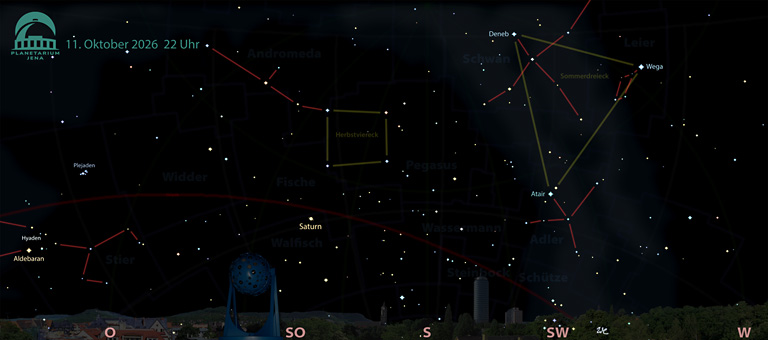
Am frühen Abend ist in südöstlicher Richtung der Ringplanet Saturn vor dem Sternbild Walfisch zu sehen. Nach Mitternacht erscheinen im Osten der rote äußere Nachbarplanet Mars vor dem Tierkreissternbild Krebs und der Riesenplanet Jupiter vor dem Tierkreissternbild Löwe und werden zu Planeten der zweiten Nachthälfte.
Die frühen Nachtstunden dokumentieren den Abschied vom Sommer, das Sommerdreieck ist bereits im Südwesten zu finden. Der Deneb im Sternbild Schwan, die Wega in der Leier – beide stehen sehr hoch – und der Atair unten bilden dieses gleichschenklige Dreieck. Südlich folgen die weniger hellen Sterne des Herbstvierecks, das aus Sternen der Sternbilder Pegasus und Andromeda besteht. Deren Sternkette weist in den Osten.
In den späteren Nachtstunden bis in den Morgen zeigen sich im Südosten bereits die Sterne des Wintersechsecks. Auffällig sind der Himmelsjäger Orion und der helle funkelnde Sirius im Großen Hund. Im Stier können wir zwei offene Sternhaufen entdecken: die Plejaden oder Siebengestirn und die Hyaden oder Regengestirn. Der rötliche Aldebaran gehört ebenso zum Wintersechseck wie Kapella hoch darüber, die Zwillinge Kastor und Pollux auf der östlichen Seite sowie Prokyon im Kleinen Hund, Sirius im Großen Hund und Rigel im Orion.
Unser innerer Nachbarplanet Venus geht am Ende des Monats in seine Periode als sogenannter „Morgenstern“ über.
W. Don Eck
Zeiss-Planetarium Jena
The starry sky in October 2026
3 Planets and the Time Change
The sun’s altitude at midday decreases from 35 degrees to 25 degrees by the end of the month, meaning that the length of daylight also falls to less than 10 hours. On the 31st, the sun leaves the zodiacal constellation Virgo and moves into Libra.
On 25 October, Central European Summer Time 2025 ends in Germany. Clocks are set back from 3 am to 2 am.
The full moon is on the 26th, the new moon on 10 October.
In the early evening, the ringed planet Saturn can be seen in the south-east, in front of the constellation Cetus. After midnight, the red outer neighbour planet Mars appears in the east against the zodiacal constellation Cancer, and the giant planet Jupiter against the zodiacal constellation Leo, becoming the planets of the second half of the night.
The early hours of the night mark the end of summer; the Summer Triangle can already be found in the south-west. Deneb in the constellation Cygnus, Vega in Lyra – both of which are very high in the sky – and Altair below form this isosceles triangle. To the south lie the dimmer stars of the Autumn Quadrangle, which consists of stars from the constellations Pegasus and Andromeda. Their chain of stars points eastwards.
In the late hours of the night and into the morning, the stars of the Winter Hexagon are already visible in the south-east. Particularly striking are Orion, the Sky Hunter, and the bright, sparkling Sirius in Canis Major. In Taurus, we can spot two open star clusters: the Pleiades, or Seven Sisters, and the Hyades, or Seven Brothers. The reddish Aldebaran is part of the Winter Hexagon, as is Capella high above it, the twins Castor and Pollux on the eastern side, as well as Procyon in Canis Minor, Sirius in Canis Major and Rigel in Orion.
Our inner neighbour, Venus, begins its period as the so-called ‘Morning Star’ at the end of the month.
Hvězdná obloha v říjnu 2026
3 planety a změna času
Polední výška Slunce se do konce měsíce sníží z 35 stupňů na 25 stupňů, čímž se zkrátí i délka světlého dne na méně než 10 hodin. 31. opustí Slunce souhvězdí Panny a přejde do souhvězdí Vah.
25. října končí v Německu středoevropský letní čas 2025. Hodiny se posunou ze 3 hodin zpět na 2 hodiny.
Úplněk je 26., nov 10. října.
Brzy večer je na jihovýchodě vidět prstencová planeta Saturn před souhvězdím Velryby. Po půlnoci se na východě objeví červená vnější sousední planeta Mars před souhvězdím Raka a obří planeta Jupiter před souhvězdím Lva a stanou se planetami druhé poloviny noci.
Rané noční hodiny dokumentují rozloučení s létem, letní trojúhelník je již k vidění na jihozápadě. Deneb v souhvězdí Labutě, Vega v souhvězdí Lyry – obě stojí velmi vysoko – a Atair dole tvoří tento rovnoramenný trojúhelník. Jižně od něj následují méně jasné hvězdy podzimního čtyřúhelníku, který se skládá z hvězd souhvězdí Pegasa a Andromedy. Jejich hvězdný řetěz směřuje na východ.
V pozdních nočních hodinách až do rána se na jihovýchodě již objevují hvězdy zimního šestiúhelníku. Zřetelně vyniká lovec Orion a jasně zářící Sirius v souhvězdí Velkého psa. V souhvězdí Býka můžeme objevit dvě otevřená hvězdokupy: Plejády neboli Sedm hvězd a Hyády neboli Dešťové hvězdy. Načervenalá hvězda Aldebaran patří do zimního šestiúhelníku stejně jako Kapella vysoko nad ní, Blíženci Kastor a Pollux na východní straně, stejně jako Prokyon v Malém psu, Sirius ve Velkém psu a Rigel v Orionu.
Naše nejbližší sousední planeta Venuše na konci měsíce přechází do období, kdy je známá jako „ranní hvězda“.