Sonnen- und Mondfinsternis, Sternschnuppen und 5 Planeten
In diesem Monat nimmt die Länge des hellen Tages bereits wieder um eine Stunde ab. Die Sonne verlässt am 11. das Tierkreissternbild Krebs und zieht vor den Löwen.
Neumond ist am 12., Vollmond am 28. August.
Am 28. August erreicht eine fast totale Mondfinsternis mit 93 Prozent ihren Höhepunkt um 6:13 Uhr. Die Finsternis findet bei uns in der Morgendämmerung statt. Schon um 6:22 Uhr geht der Mond unter.
Zuvor richten wir unseren Blick auf den 12. August. Bei uns in Jena können wir eine partielle Sonnenfinsternis mit immerhin 86,5 % Bedeckung um 20:11 Uhr sehen. Die Sonne steht aber mit nur 3,4° Höhe über dem Westhorizont kurz vor dem Untergang.
Die totale Sonnenfinsternis ist in einem schmalen Streifen über dem Nordpolarmeer, Grönland, dem nördlichen Atlantik, Island und Spanien beobachtbar. Das Maximum der Finsternis liegt westlich von Island im Atlantik. Die totale Phase dauert dort 2 Minuten und 18 Sekunden.
(https://de.wikipedia.org/wiki/Sonnenfinsternis_vom_12._August_2026)
ACHTUNG, schauen Sie nicht mit dem ungeschützten Auge in die Sonne!
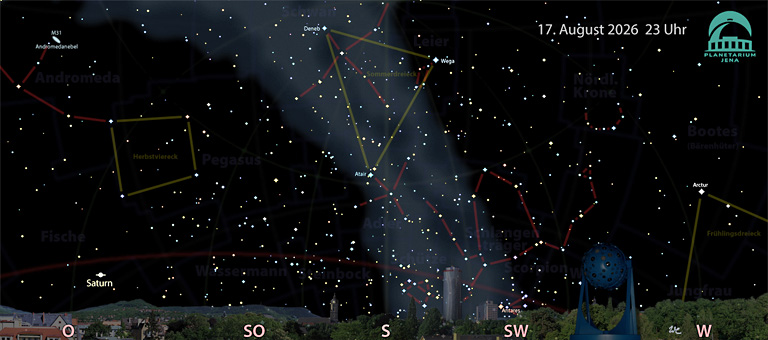
In diesem Monat können wir schon in der Dämmerung im Westen unseren inneren Nachbarplaneten des Sonnensystems, die Venus, entdecken. Im Osten erscheint der Ringplanet Saturn vor dem Tierkreissternbild Fische und ist fast die ganze Nacht sichtbar.
Die Hochsommernächte werden vom Sommerdreieck beherrscht. Hoch im Süden funkeln mit Deneb im Schwan und Wega in der Leier zwei der hellsten Sterne am irdischen Himmel. Unter ihnen vollendet der Atair im Adler das prachtvolle Dreieck. Das Sternbild Schwan ist auch als Kreuz des Nordens gut zu finden. In einer ganz klaren Nacht kann man sich gut vorstellen, wie beide Vögel mit ausgebreiteten Schwingen über das matt schimmernde Band der Milchstraße zu gleiten scheinen. Aber dafür sind schon sehr gute Sichtbedingungen erforderlich. Vier nicht sehr lichtstarke Sternchen, die ein kleines Parallelogramm bilden, formen zusammen mit der Wega das Sternbild Leier. Flach über dem Südhorizont sind die sommerlichen Tierkreissternbilder Waage, Skorpion, Schlangenträger, Schütze und Steinbock zu finden. Der rötlich funkelnde Stern Antares des Skorpions ist recht gut auszumachen.
Am östlichen Himmel strahlen die Sterne des Herbstvierecks aus Pegasus und Andromeda.
Scheinbar aus dem Sternbild Perseus im Osten kommend, kann man ab Mitte des Monats die Sternschnuppen des Perseiden-Stroms erwarten, deren Maximum in der Nacht vom 12. zum 13. August liegt.
Der äußere Nachbarplanet Mars taucht am Morgenhimmel im Nordosten auf. Ende August wird der helle Riesenplanet Jupiter in den Morgenstunden im Nordosten sichtbar. Anfang August kann der sonnennächste Planet Merkur kurz vor Sonnenaufgang im Nordosten beobachtet werden.
W. Don Eck
Zeiss-Planetarium Jena
The starry sky in August 2026
Solar and lunar eclipses, shooting stars and five planets
This month, the length of daylight is already decreasing by an hour again. On the 11th, the Sun leaves the zodiacal constellation of Cancer and moves into Leo.
The new moon is on the 12th, and the full moon on 28 August.
On 28 August, a near-total lunar eclipse, covering 93 per cent of the Moon, will reach its peak at 6.13 am. The eclipse will take place here during the early hours of the morning. The Moon will set as early as 6.22 am.
Before that, let’s turn our attention to 12 August. Here in Jena, we’ll be able to see a partial solar eclipse with a coverage of 86.5 per cent at 8.11 pm. However, the Sun will be just 3.4° above the western horizon, shortly before setting.
The total solar eclipse will be visible along a narrow strip across the Arctic Ocean, Greenland, the North Atlantic, Iceland and Spain. The maximum of the eclipse will occur west of Iceland in the Atlantic Ocean. The total phase will last 2 minutes and 18 seconds there.
(https://de.wikipedia.org/wiki/Sonnenfinsternis_vom_12._August_2026)
WARNING: do not look at the Sun with the naked eye!
This month, we can already spot Venus, our innermost neighbouring planet in the Solar System, in the west at dusk. In the east, the ringed planet Saturn appears against the zodiacal constellation of Pisces and is visible for almost the whole night.
The midsummer nights are dominated by the Summer Triangle. High in the southern sky, Deneb in Cygnus and Vega in Lyra – two of the brightest stars in the Earth’s sky – twinkle. Between them, Altair in Aquila completes the magnificent triangle. The constellation Cygnus is also easy to spot as the Northern Cross. On a perfectly clear night, it is easy to imagine how both birds seem to glide with outstretched wings across the faintly shimmering band of the Milky Way. However, this does require very good visibility. Four faint little stars, forming a small parallelogram, together with Vega make up the constellation Lyra. Low above the southern horizon lie the summer zodiacal constellations Libra, Scorpio, Ophiuchus, Sagittarius and Capricorn. The reddish, sparkling star Antares in Scorpio is quite easy to spot.
In the eastern sky, the stars of the Autumn Quadrangle, comprising Pegasus and Andromeda, shine brightly.
Seemingly originating from the constellation Perseus in the east, the shooting stars of the Perseid meteor shower can be expected from the middle of the month onwards, with the peak occurring on the night of 12–13 August.
Mars, the outermost neighbouring planet, appears in the north-eastern morning sky. Towards the end of August, the bright giant planet Jupiter will be visible in the north-east during the morning hours. At the beginning of August, Mercury, the planet closest to the Sun, can be observed in the north-east shortly before sunrise.