3 Planeten
Unsere Erde erreicht am 6. den sonnenfernsten Punkt ihrer Bahn. Trotzdem herrscht bei uns Hochsommer, der helle Tag ist immer noch länger als 15 Stunden. Die Sonne zieht am 21. Juli vom Tierkreissternbild Zwillinge zum Krebs.
Vollmond ist am 29. Juli, Neumond am 14.
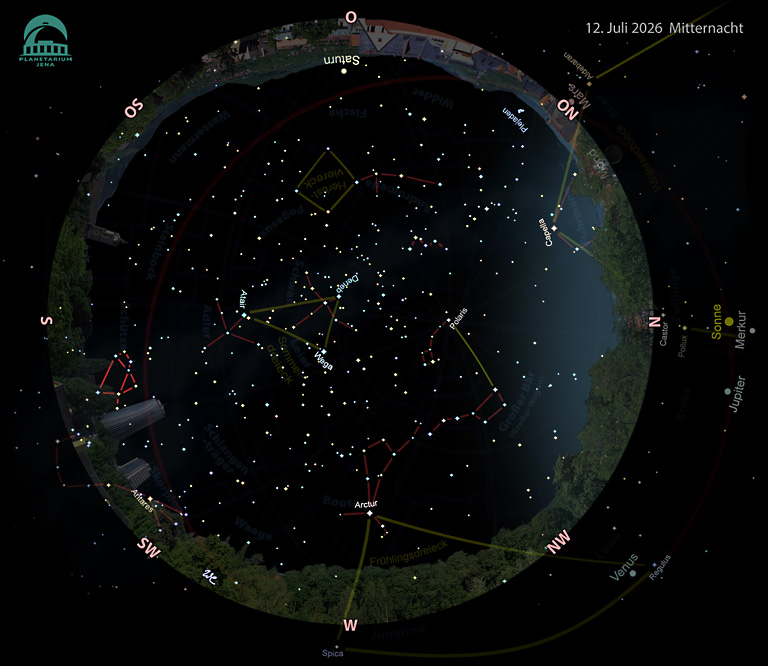
Planet Venus ist in der Abenddämmerung in westlicher Richtung der sogenannte „Abendstern“. Saturn folgt in der zweiten Nachthälfte vor dem Tierkreissternbild Fische. Gegen Ende des Monats beginnt er mit der Oppositionsschleife.
Im Südwesten beginnt sich das Frühlingsdreieck vom Abendhimmel zu verabschieden. Nur der relativ hochstehende Arktur wird noch einige Monate rötlich funkeln. Gegen Mitternacht dominieren hoch im Süden die hellen Sterne des Sommerdreiecks: Deneb, der Schwanzstern im Sternbild Schwan – auch als Kreuz des Nordens bekannt, westlich daneben die Wega in der Leier und Richtung Horizont ist es der Atair im Adler.
Östlich folgen die weniger lichtstarken Sterne des Herbstvierecks, das jedoch durch seine markante Form gut zu entdecken ist und nach und nach den morgendlichen Himmel beherrschen wird.
Der rote Nachbarplanet Mars erscheint im Nordosten vor dem Tierkreissternbild Stier. Merkur zeigt sich noch nicht am Morgenhimmel.
W. Don Eck
Zeiss-Planetarium Jena
The starry sky in July 2026
3 planets
On the 6th, our Earth reaches the point in its orbit furthest from the Sun. Nevertheless, it is the height of summer here, and daylight still lasts for more than 15 hours. On 21 July, the Sun moves from the zodiacal constellation of Gemini into Cancer.
The full moon is on 29 July, and the new moon on 14 July.
The planet Venus is visible in the west at dusk as the so-called ‘Evening Star’. Saturn follows in the second half of the night, set against the zodiacal constellation of Pisces. Towards the end of the month, it begins its opposition cycle.
In the south-west, the Spring Triangle begins to fade from the evening sky. Only Arcturus, which is relatively high in the sky, will continue to twinkle reddish for a few more months. Around midnight, high in the south, the bright stars of the Summer Triangle dominate: Deneb, the tail star in the constellation Cygnus – also known as the Northern Cross – to the west of it is Vega in Lyra, and towards the horizon is Altair in Aquila.
To the east lie the fainter stars of the Autumn Square, which is nevertheless easy to spot thanks to its distinctive shape and will gradually come to dominate the morning sky.
The red neighbouring planet, Mars, appears in the north-east against the backdrop of the zodiacal constellation Taurus. Mercury is not yet visible in the morning sky.