Sommersonnenwende
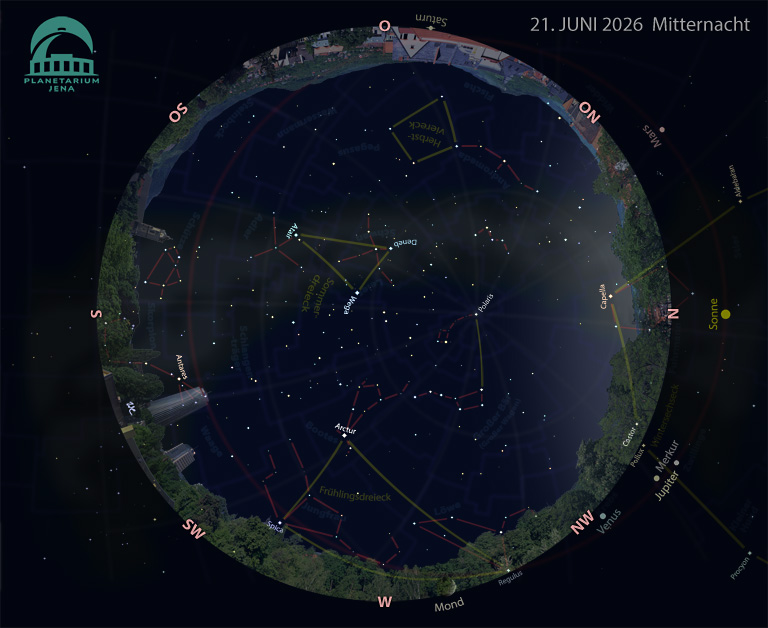
Zu Mitternacht steht die Sonne nur etwa 16 Grad unterhalb des Nordhorizonts. Das bedeutet, dass das Ende der astronomischen Dämmerung in unseren Breiten nicht ganz erreicht wird, die Nacht nicht völlig dunkel wird. Im hohen Norden führt das zu den „Weißen Nächten“ und nördlich des Polarkreises zur „Mitternachtssonne“. In Jena beginnt der diesjährige Sommer astronomisch am 21. Juni um 10:23 Uhr MESZ. Die Sonne zieht vor dem Tierkreissternbild Stier in Richtung Zwillinge.
Vollmond ist am 30., Neumond am 14. Juni.
Unter günstigen Bedingungen können wir bis Anfang Juni in der Dämmerung im Nordwesten den raren Merkur, den innersten Planeten unseres Sonnensystems, entdecken. Ihm folgen die Venus und der Jupiter. Am 9. überholt die Venus den Jupiter. Jupiter verabschiedet sich gegen Monatsende vom Nachthimmel.
Bald verabschieden sich am Westhorizont die Sterne des Frühlingsdreiecks, Regulus im Löwen, Spika in der Jungfrau und Arktur im Bootes.
Im Süden funkelt der rötliche Antares im Tierkreissternbild Skorpion. Hoch darüber sind es die hellen Sterne des Sommerdreiecks: Deneb im Schwan, Wega in der Leier und Atair im Adler. Deutlich tritt das „Kreuz des Nordens“ in der Figur des Schwans hervor.
Die Sterne des Herbstvierecks erscheinen morgens im Osten.
Saturn kann am Morgen am Osthorizont gesehen werden. Mars ist noch nicht am Morgenhimmel zu sehen.
W. Don Eck
Zeiss-Planetarium Jena
The starry sky in June 2026
Summer Solstice
At midnight, the sun is only about 16 degrees below the northern horizon. This means that, in our latitudes, astronomical twilight does not fully end, and the night does not become completely dark. In the far north, this leads to the ‘White Nights’ and, north of the Arctic Circle, to the ‘Midnight Sun’. In Jena, this year’s summer begins astronomically on 21 June at 10:23 CEST. The Sun moves past the zodiac constellation Taurus towards Gemini.
The full moon is on the 30th, the new moon on 14 June.
Under favourable conditions, we can spot the rare Mercury, the innermost planet of our solar system, in the twilight in the north-west until early June. It is followed by Venus and Jupiter. On the 9th, Venus overtakes Jupiter. Jupiter bids farewell to the night sky towards the end of the month.
Soon, the stars of the Spring Triangle – Regulus in Leo, Spica in Virgo and Arcturus in Bootes – will disappear below the western horizon.
In the south, the reddish Antares twinkles in the zodiacal constellation of Scorpio. High above them are the bright stars of the Summer Triangle: Deneb in Cygnus, Vega in Lyra and Altair in Aquila. The ‘Northern Cross’ stands out clearly in the constellation Cygnus.
The stars of the Autumn Square appear in the east in the morning.
Saturn can be seen on the eastern horizon in the morning. Mars is not yet visible in the morning sky.
El cielo estrellado en junio de 2026
Solsticio de verano
A medianoche, el sol se encuentra a solo unos 16 grados por debajo del horizonte norte. Esto significa que, en nuestras latitudes, no se alcanza del todo el final del crepúsculo astronómico, por lo que la noche no llega a ser completamente oscura. En el extremo norte, esto da lugar a las «noches blancas» y, al norte del círculo polar ártico, al «sol de medianoche». En Jena, el verano de este año comienza astronómicamente el 21 de junio a las 10:23 a. m. CEST. El sol se desplaza frente a la constelación de Tauro hacia Géminis.
La luna llena es el 30 y la luna nueva el 14 de junio.
En condiciones favorables, hasta principios de junio podremos descubrir al atardecer, en el noroeste, al escaso Mercurio, el planeta más interno de nuestro sistema solar. Le siguen Venus y Júpiter. El día 9, Venus adelanta a Júpiter. Júpiter se despide del cielo nocturno hacia finales de mes.
Pronto desaparecerán por el horizonte occidental las estrellas del Triángulo de Primavera: Regulus en Leo, Spica en Virgo y Arcturus en Boötes.
En el sur brilla la rojiza Antares, en la constelación de Escorpio. Muy por encima de ella se encuentran las brillantes estrellas del Triángulo de Verano: Deneb en el Cisne, Vega en la Lira y Altair en el Águila. La «Cruz del Norte» destaca claramente en la figura del Cisne.
Las estrellas del Cuadrilátero de Otoño aparecen por la mañana en el este.
Saturno se puede ver por la mañana en el horizonte oriental. Marte aún no se ve en el cielo matutino.